
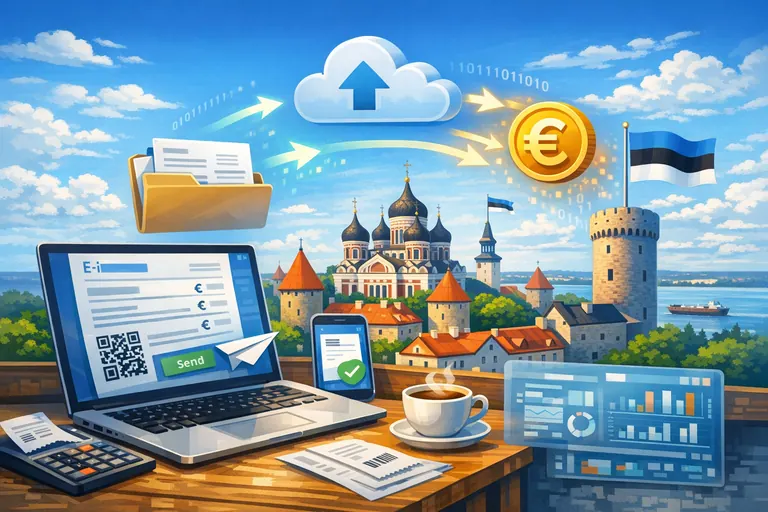
After helping companies implement e-invoicing for years, I can say the biggest benefit is not “compliance”. It’s operational: fewer manual entries, fewer mistakes, faster approvals, and cleaner bookkeeping.
This guide explains e-invoicing in Estonia as of January 2026: what it is, which formats are common, and a step-by-step rollout plan you can actually execute without an ERP project.
Before rollout, validate the baseline in official sources: EMTA guidance on VAT accounting and invoices and the Value Added Tax Act (KMS).
In practice, implementation succeeds when the invoice flow is tied to month-end routines. Pair this with the accounting software comparison and the VAT declaration guide before you configure channels.
If you want to validate your scenario before filing deadlines, contact us and we will map the safest implementation path for your company.
What Estonia means by “e-invoice”
An e-invoice is a structured, machine-readable invoice sent system-to-system. It is not the same as a PDF attachment. A good e-invoice contains all required invoice data in a standard format, so the receiver can import it automatically.
Common terms you’ll see in Estonia:
- Finvoice: a widely used format in the region.
- Peppol: an EU-standard network and format family used for cross-border exchange.
- e‑arve: the Estonian term for e-invoice.
When you should care in 2026
You may need or want e-invoices if:
- you invoice public sector entities or larger companies that prefer structured invoices
- you process many supplier invoices and want automated matching/approval
- you want to reduce bookkeeping costs and month-end stress
If you’re not sure, ask your top 5 customers and top 5 suppliers what they accept. E-invoicing is a two-sided process.
Choose your setup: 3 practical routes
- Accounting software with e-invoicing built in (common for small and mid-sized OÜ).
- E-invoicing operator connected to your software or invoice tool.
- Peppol access point if your customers require Peppol or you invoice internationally.
If you are currently choosing software, start with: Best Accounting Software Estonia 2026.
Implementation checklist (step-by-step)
Step 1: Clean your invoice “master data”
- Company registry code and VAT number (if applicable)
- Correct legal name and address
- Bank account details and payment terms
- Consistent invoice numbering rules
Step 2: Decide on your format/channel
Choose the route your partners can receive. Many businesses start with local operator routes and add Peppol later if needed.
Step 3: Register your receiving address (if applicable)
In Estonia, many companies publish their e-invoice receiving capability in the public register so partners can find them. A common reference point is earveldaja.ee.
Step 4: Configure sending rules
Decide what happens when an invoice fails validation: who fixes it, and how quickly. Set default VAT codes, item descriptions, and contact data to reduce rejections.
Step 5: Configure receiving + approval workflow
Receiving e-invoices is where the real efficiency comes from. Define:
- who approves invoices
- what matching rules you use (purchase orders, projects, cost centers)
- where documents are archived and for how long
Step 6: Run a pilot
Start with 1–2 customers and 1–2 suppliers. Test end-to-end: issue, delivery, import, approval, payment, and accounting entry.
The technical part is usually the easy part. The rollout fails when the company has no rule for who approves invoices and who fixes rejected ones. Treat e-invoicing as a process project, not a file format.
Common issues (and how to prevent them)
- Invoice rejected: usually missing mandatory fields or invalid identifiers. Fix master data first.
- Wrong VAT treatment: align VAT logic with your actual business model and review when you add new markets.
- Attachments lost: agree internally how you store contracts, delivery notes, and confirmations alongside e-invoices.
See also: VAT Declaration in Estonia: Complete Guide 2026.
Minimum viable rollout for a small OÜ
If you don’t want an “ERP project”, start small. In my practice, the fastest wins come from receiving e‑invoices and building a clean approval workflow.
- Pick 5–10 suppliers you work with every month and ask for structured invoices.
- Define who approves and what happens when an invoice is rejected.
- Run one month in parallel (old flow vs new flow) and compare time spent.
- Only then expand to more partners and add sending automation.
For software choices that support e‑invoice workflows, see: Accounting software Estonia comparison.
Quick checklist (January 2026)
If you’re implementing this guide around e-invoicing in Estonia, use this short checklist to turn it into action. It’s the same structure I recommend to clients who want fewer surprises and a calmer month-end.
- Write scope first: what you need monthly, quarterly, and annually — and what you don’t.
- Collect documents early: aim to have everything in one place by the 5th.
- Use a single owner: one person responsible for “close the month”, even if tasks are delegated.
- Keep e‑MTA access clean: authorizations, contacts, and responsibility should be explicit.
- Review edge cases monthly: cross‑border VAT, payroll changes, unusual transactions.
- Document decisions: payments, reimbursements, and policies should be written, not implied.
Related reading: Emta Deadlines 2026: Complete Estonian Tax Calendar · VAT Declaration in Estonia: Complete Guide 2026.
See also: Tax Optimization for Startups in Estonia 2026: Legal Strategies · Best Accounting Software Estonia 2026: Complete Comparison.
Conclusion
E-invoicing is one of those upgrades that pays back quickly when implemented with a clear process. Start small, get your data clean, and expand once the workflow is stable.
If you want us to help you choose a setup and implement it without disrupting operations, contact AccRes.
Frequently asked questions
Is a PDF invoice an e-invoice in Estonia?
No. A PDF is still a document, but an e-invoice is structured data exchanged between systems (Finvoice/Peppol or similar).
Do I need Peppol for e-invoicing in Estonia?
Not always. It depends on your customers and your operator/software options. Peppol is especially useful for cross-border invoicing.
How do I get an e-invoice address?
Usually through your software or an operator. Many companies also publish their receiving capability in the public register.
Can a small OÜ receive e-invoices without buying an ERP?
Yes. You can use a lightweight accounting system or an operator connection. The value comes from structured invoices and a clear approval workflow. See also: invoice requirements in Estonia.
What is the most common implementation mistake?
Bad master data and unclear responsibilities (who approves, who fixes rejected invoices). Process beats tooling. As stated in Accounting Act (RPS), it is worth verifying the latest requirements before applying this step.