
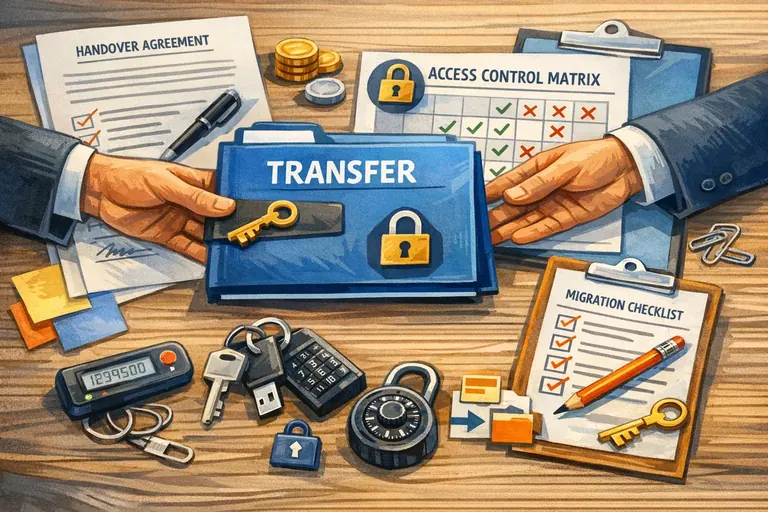
Switching accounting provider in Estonia: handover act, access matrix, cutoff plan, and first-month controls so nothing gets lost during transition.
Why provider switches fail
Most accounting-provider transitions fail for boring reasons: incomplete access lists, missing source files, unclear cut-off dates, and nobody explicitly owning the old month versus the new month. The risk is not the change itself; the risk is treating the handover as an email exchange instead of a controlled project.
The company should define one cutover date, one handover register, and one decision-maker. Without that, open VAT items, payroll corrections, and half-closed months move between providers until nobody is sure what has actually been filed.
If you are switching because of service quality, document the issues first. A structured handover works best when paired with a clean review of your existing agreement and the control weaknesses visible in your owner dashboard.
Create a handover register before you terminate anything
The handover register should list every asset the next provider needs:
- accounting files, exports, and chart-of-accounts logic;
- source-document archive and naming rules;
- bank integrations, e-invoice connections, and approval workflows;
- e-MTA access, Employment Register access, and any portal credentials;
- open questions by month: unreconciled balances, VAT topics, payroll adjustments, and board approvals still missing.
Do this before sending the termination notice. Otherwise the company starts negotiating access only after trust is already damaged.
Use a 14-day cutover plan
A clean switch usually follows a short but explicit timeline. Days 1-3: freeze the reporting perimeter and assign owners for each open month. Days 4-7: collect exports, source files, and access confirmations. Days 8-10: the new provider reviews opening balances and flags missing data. Days 11-14: management approves the handover act and confirms what month the new provider will fully own.
Do not change the month-end calendar during the same week. If the old provider still owns one filing, leave that responsibility explicit in writing. Hybrid periods are where missed declarations happen.
Access control is more important than document transfer
Documents can be resent. Credentials, delegated rights, and approval paths are harder to reconstruct after the switch. The company should keep an access matrix showing:
- who holds legal submission rights in e-MTA and business registers;
- who can see bank feeds and payment data;
- who can approve payroll, expenses, or management reports;
- who revokes access when the switch is complete.
If no one from management owns the revocation list, the company often ends up with former vendors still able to view live data. That is a governance problem, not just an IT task.
Define acceptance criteria for the first month
The switch is not finished when files are delivered. It is finished when the first month closes cleanly with the new provider. Set acceptance criteria in advance: opening balances agreed, bank and VAT ledgers reconciled, payroll assumptions confirmed, and management aware of all inherited exceptions.
That first-month review should be stricter than usual. Compare the new close against the company's normal month-end controls and the risks listed in your recurring accounting mistakes review.
Close the old relationship properly
Terminate the old relationship with the same discipline you expect from the new one. Sign a handover act, confirm the list of transferred materials, record any unresolved items, and state who remains responsible for periods already filed or under review.
This protects both sides. It also gives the new provider a cleaner starting point because they are not guessing whether an old issue is still open, already filed, or simply undocumented.
A provider change should leave the company with better controls than before. If the new setup still relies on verbal promises and ad hoc exports, you changed vendor but not the risk profile.
In my experience, switch accounting provider Estonia becomes risky only after responsibilities stay verbal for too long. Write the owner, cut-off, and review step before the busy week starts.
Frequently asked questions
Who should sign the handover act?
A company representative with decision authority, plus the outgoing and incoming provider where possible. The point is to document responsibility, not just receipt of files.
When should we revoke old access?
Immediately after the company confirms that all required files and rights have been transferred and tested.
Can both providers work in parallel for one month?
Yes, but only with written ownership of each filing and each approval. Parallel work without scope clarity creates duplicate risk.
What if the old provider refuses to cooperate?
Escalate through the contract, document every missing item, and secure legal or technical control of portals first. Access and records matter more than argument.
What is the main acceptance test?
A clean first close with reconciled balances, confirmed filings, and no unresolved access or source-document gaps.