
Filing is a control process, not the final click in the register
File financial statements Estonia sounds like a filing task, but the risk sits earlier. For an OÜ, delays usually come from unreconciled balances, missing note disclosures, late board approval, or the discovery that the right person does not have submission access when the package is finally ready.
The underlying reporting obligations come from the Accounting Act (RPS) and the filing duty is anchored in the Commercial Code (ÄS). When teams treat these requirements as something to check only on submission day, the timeline collapses into rework and last-minute escalation.
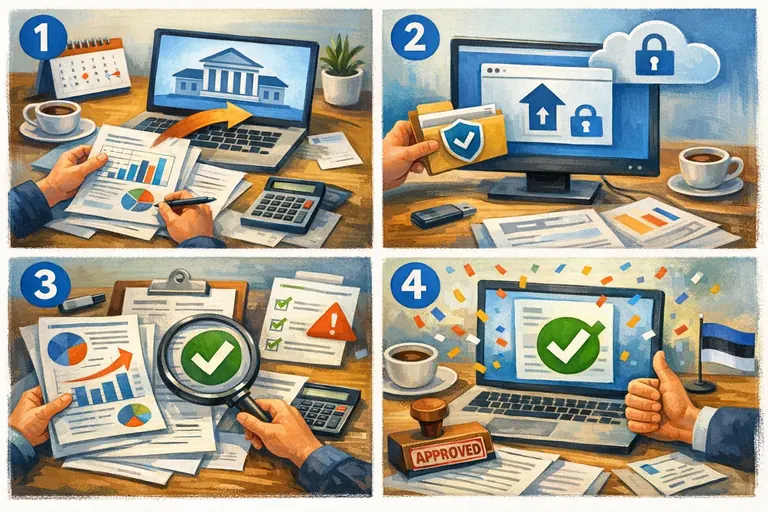
A safer workflow has five stages: close the accounting period, reconcile statement lines, prepare notes and management materials, run a pre-filing check, and then submit through one accountable owner. That order matters because fixing the package after approval is usually slower than building it correctly once.
This article breaks down that sequence so founders and accountants can see where filing gets blocked and how to reduce avoidable corrections before the deadline week starts.
Operating Model: Ownership, Boundaries, Control
A resilient structure follows “prepare — review — approve.” Execution and quality review must be separated, while exception decisions belong to management. This reduces key-person dependency and keeps quality stable during team changes.
For every recurring task define an explicit owner, deadline, and acceptance criterion. Without these three elements, SLA discussions become subjective and quality cannot be measured consistently.
Pre-Filing Validation Checklist
- All mandatory sections completed and internally reviewed.
- Numbers reconciled across statements and notes.
- Board approval trail documented with dates.
- Submission access tested in advance, including backup user.
- Exception log closed or explicitly accepted by management.
Teams that validate these five points reduce rework and shorten the filing window dramatically.
Step-by-Step Workflow for an OÜ Team
- Agree yearly calendar with mandatory milestones and review buffer.
- Standardize document package and submission channel.
- Assign quality gate before external filing and board reporting.
- Add escalation rule for any delay above one business day.
- Run monthly root-cause review of recurring errors.
Consistency beats complexity. A simple repeated cycle usually delivers more control than a sophisticated process used only during crises.
Day-by-Day Filing Window
Set a fixed window: day 1 for technical checks, day 2 for board review, day 3 for submission and archive. This rhythm turns filing from a rush task into a controlled routine.
Control Matrix: Risk → Impact → Action
| Risk | Business Impact | Control Action |
|---|---|---|
| No formal process around “file financial statements Estonia” | Deadline slippage, team overload, rework cost | Written workflow and named owner per phase |
| Inconsistent source documents | Reporting errors and reconciliation delays | Standardized input package and intake checklist |
| Quality control only at the end | Re-filing risk and penalty exposure | Two-level review before submission |
The matrix works only when each risk has an owner and due date. Otherwise it becomes a passive list with no execution force.
What International Founders Usually Miss
Cross-border founders often underestimate access governance. Keep one master register of e-service permissions, banking rights, and filing authority. This single practice reduces operational risk during provider or staff transitions.
Another common miss is decision logging. Monthly notes on assumptions, exceptions, and approvals preserve context and prevent repeated mistakes after role changes.
Distributed teams should avoid approval delays by agreeing a single decision timezone for filing week. This removes ambiguity when signatures are collected across countries.
30-Day Implementation Plan
- Week 1: formalize roles, SLA, and data handover protocol.
- Week 2: standardize document templates and checks.
- Week 3: run one full pilot cycle and capture deviations.
- Week 4: launch recurring KPI review with owners.
Internal links: annual report deadlines for OÜ, how to choose an accountant in Estonia, annual report preparation plan.
If filing deadlines feel risky, compare accounting services in Estonia and formalize a repeatable submission workflow.
A documented filing cadence is one of the highest-leverage controls for reducing annual-report stress and avoiding preventable delays.
Most missed filing dates are not caused by difficult accounting questions. They happen because the first complete package reaches the final reviewer too late, when there is no buffer left for corrections.
If you need help turning a rushed filing routine into a repeatable close-and-submit process, contact us. We can review the sequence, controls, and responsibilities before the deadline closes in.
Frequently asked questions
Where should we start with “file financial statements Estonia”?
Start by documenting ownership and deadlines. Without explicit accountability, improvements do not stick.
Do small OÜ teams need a formal control model?
Yes. Keep it lightweight, but separate execution from review.
Which KPIs show real progress?
Track on-time completion, post-review corrections, and total closing duration.
Can this work without expensive tooling?
Yes. Process discipline usually matters more than software complexity in early stages.
How does this support annual reporting?
Monthly controls reduce cumulative errors and make year-end filing predictable.