
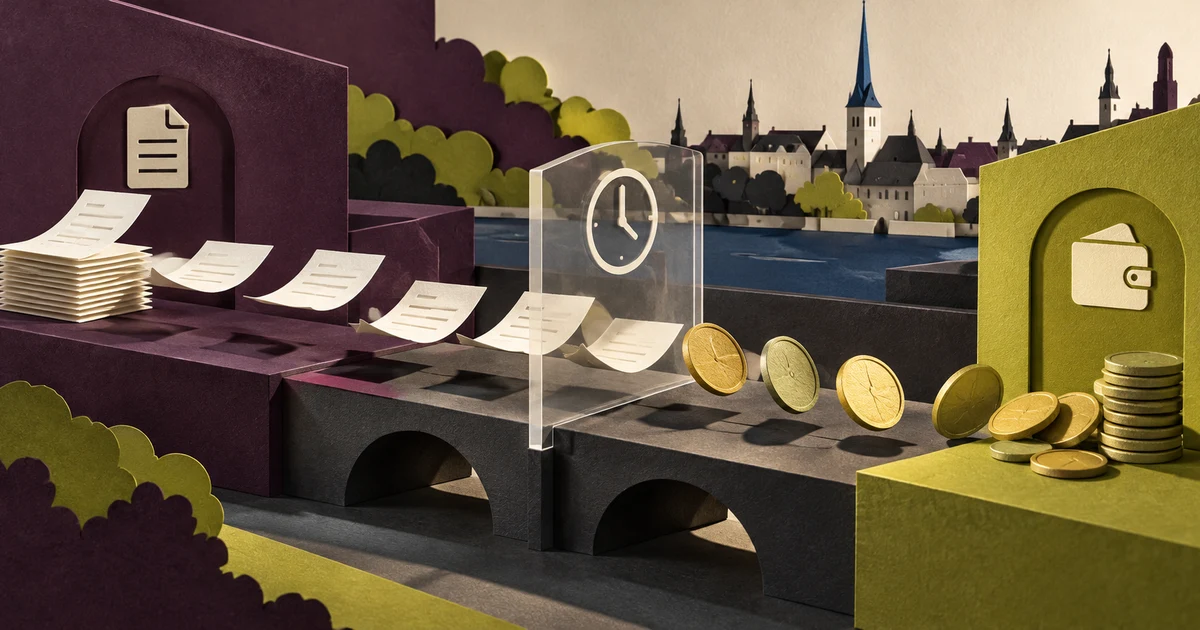
Cash accounting VAT in Estonia can protect cash flow when customers pay slowly, but it does not turn every VAT transaction into a payment-date entry. A consultancy issues a domestic invoice for EUR 1,240, receives 40% in September and the rest in October. Under the special arrangement, the EUR 240 output VAT is split between those payment months. Under the general arrangement, the full amount would normally belong to September.
In my accounting work, the decisive questions are eligibility, advance notification and transaction type. The EUR 200,000 ceiling is only the first gate. The company also needs payment-level records, the required invoice wording and a separate route for excluded cross-border transactions. This guide explains the choice with one worked example and the controls needed for KMD and KMD INF.
Test eligibility before choosing the payment basis
Under § 44 of the Value-Added Tax Act, the arrangement is available when the relevant supply whose place of supply is Estonia did not exceed EUR 200,000 in the previous calendar year or from the beginning of the current calendar year. The ceiling is tracked on a cash basis. Disposals of fixed assets and occasional transfers of immovable property as goods are excluded from that ceiling calculation.
The choice is not automatic. Notify EMTA when registering for VAT or no later than the taxable period before the change. EMTA’s application guidance places the notification in e-MTA under the VAT registration applications. Keep the acceptance and effective date with the VAT accounting policy; do not backdate the method merely because an invoice remains unpaid.
Split VAT when the customer pays in instalments
Assume a domestic taxable service is completed and invoiced on 5 September for EUR 1,000 plus 24% VAT, total EUR 1,240. The customer pays EUR 496 on 20 September and EUR 744 on 20 October. Forty per cent of the taxable value and VAT belongs to September; the remaining 60% belongs to October. The invoice still exists from September, but output VAT follows the two receipts.
Record each receipt against the original invoice rather than treating the bank amount as unidentified turnover. Under the cash method, September KMD includes EUR 400 taxable value and EUR 96 VAT; October includes EUR 600 and EUR 144. Add the required cash-accounting reference to the invoice so the buyer knows that its own input-VAT timing may also depend on payment.
| EUR 1,240 invoice | General method | Cash method |
|---|---|---|
| Invoice issued 5 September | EUR 240 VAT in September | No receipt yet |
| EUR 496 received 20 September | No second VAT event | EUR 96 VAT in September |
| EUR 744 received 20 October | No second VAT event | EUR 144 VAT in October |
| Total output VAT | EUR 240 | EUR 240 |
Match input VAT and returns to actual payments
The timing works in both directions. EMTA’s cash-accounting guidance states that eligible input VAT is deductible when the business pays for the purchase, and only in the paid proportion. If a valid EUR 620 business invoice contains EUR 120 VAT and the company pays half in September and half in October, the potential deduction is EUR 60 in each month, subject to the ordinary business-use and deduction rules.
Cash accounting does not remove the filing cycle. Submit KMD and KMD INF by the 20th day of the following month and reconcile invoice totals, paid portions, output VAT and input VAT. An invoice can therefore appear in the supporting records before all of its taxable value reaches KMD. A ledger that stores only an invoice date and one paid flag is not enough for partial payments.
Keep excluded transactions and the exit month separate
The special arrangement does not apply to imports, intra-Community supplies or acquisitions, specified B2B services supplied to another Member State, or relevant services received from a foreign business when their place of supply is outside Estonia. These entries follow their own VAT timing. A company with domestic consulting and EU services may therefore run cash and general rules side by side in the same month.
If the tracked supply exceeds EUR 200,000 from the start of the calendar year, stop using the arrangement from the first day of the following calendar month and notify EMTA during the first affected taxable period. A voluntary exit also requires advance notice. Preserve the old-method receivables and payables schedule after the switch, because later payments relating to the cash-accounting period still need correct treatment.
I do not approve cash accounting from a revenue forecast alone. I first map domestic and cross-border transactions, then test whether the bookkeeping system can split every receipt and payment by invoice. The method improves cash timing only when that payment ledger is reliable.
Cash accounting changes VAT timing, not the tax rate or documentation standard. Confirm the EUR 200,000 eligibility test, notify EMTA before the start date, mark invoices, split partial payments and keep excluded transactions on their statutory route. See also: VAT declaration in Estonia.
If you want to compare the cash and general methods using your receivables and supplier terms, send the transaction mix through the AccRes contact form before changing the KMD workflow.